
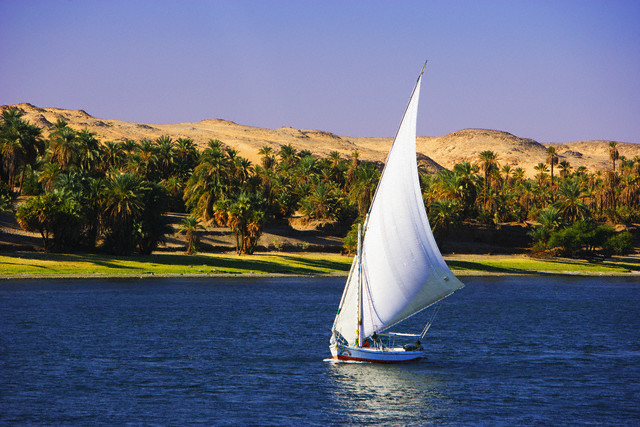
The River Nile: A Lifeline of Egypt
The River Nile, often referred to as the “lifeblood of Egypt,” is one of the world’s most iconic and historically significant waterways. Spanning over 4,100 miles (6,650 kilometers), it winds its way through eleven countries, with its most prominent and influential stretch flowing through Egypt. A symbol of abundance, fertility, and civilization, the Nile has shaped the landscape, culture, and history of Egypt for thousands of years. In this article, we will explore the river’s significance, its geographical features, and its cultural and historical importance to Egypt.

Geographical Features:
The Nile River is formed by two main tributaries: the White Nile and the Blue Nile. The White Nile originates from Lake Victoria in East Africa, while the Blue Nile begins in the Ethiopian highlands. These two tributaries converge near Sudan’s capital, Khartoum, forming the Nile, which then flows northward through Egypt and eventually empties into the Mediterranean Sea.
The Nile Delta, located at the river’s northern end, is a vast fertile region shaped by the river’s sediment deposits over centuries. It is an agriculturally rich area and home to several cities, including Alexandria and Cairo, the capital of Egypt.
Cultural and Historical Importance:
The Nile has played a pivotal role in the development of Egyptian civilization. Ancient Egyptians depended on the river’s annual flooding, which deposited nutrient-rich silt, to cultivate crops. They developed sophisticated irrigation systems to harness the river’s waters for agriculture, allowing them to flourish and build one of the greatest civilizations in history.
The Nile also served as a vital transportation route, facilitating trade and communication between different regions of Egypt. It enabled the movement of goods, people, and ideas, contributing to the cultural exchange and development of the ancient Egyptian society.
Furthermore, the Nile was deeply intertwined with the ancient Egyptian religion and mythology. It was revered as a deity, with the god Hapi personifying the river’s life-giving properties. The annual flooding of the Nile was seen as a divine event, marking the beginning of the agricultural season and symbolizing rebirth and renewal.
Modern Significance:
Even in modern times, the Nile remains of great importance to Egypt. It continues to provide water for irrigation, supporting agriculture and sustaining the livelihoods of millions of Egyptians. The Aswan High Dam, constructed in the 1960s, has helped regulate the river’s flow, control flooding, and generate hydroelectric power, contributing to Egypt’s economic development.
The Nile’s cultural significance is also evident in Egypt’s tourism industry. Visitors from around the world are drawn to its majestic beauty, taking cruises along the river, exploring ancient temples, and witnessing the vibrant daily life along its banks. Iconic sites such as Luxor and Aswan, with their temples and historical treasures, owe their existence and preservation to the Nile’s influence.
Conclusion:
The River Nile stands as a testament to the enduring power of nature and its profound impact on human civilization. It has shaped Egypt’s history, provided sustenance to its people, and inspired awe and wonder for millennia. As the Nile continues to flow through the heart of Egypt, it remains a symbol of life, prosperity, and the timeless connection between humanity and the natural world.


Comment (0)